Pregnancy skincare: which ingredients to avoid, and what to ask your doctor about
Retinoids, including over-the-counter retinol, and hydroquinone top the avoid list in pregnancy. What to use sparingly, what dermatologists suggest instead, and how our flags work.
Short answer
Dermatologists advise not using retinoids during pregnancy, and that includes over-the-counter retinol, retinal, retinyl esters such as retinyl palmitate, and adapalene, as well as prescription tretinoin and tazarotene. Hydroquinone is on the same list. Salicylic acid above 2% and benzoyl peroxide are ones to use sparingly. If you are pregnant, trying to conceive or breastfeeding, show your doctor or pharmacist everything you put on your skin, because no cosmetic is tested and approved as pregnancy safe.
We may earn a commission when you buy through links on this page. It never changes what we recommend.
What this means for you
Start with what you notice
Keep a skincare routine going while pregnant or breastfeeding without guessing which products are a problem.
The ingredient names, translated
A few skincare ingredients are related to medicines that can harm a developing baby, or are absorbed through the skin in larger amounts. Retinoids are the main group: they are vitamin A ingredients sold as retinol, retinal or retinyl palmitate in creams and serums, and as adapalene, tretinoin or tazarotene for acne. Hydroquinone, a skin-lightening ingredient, is the other one dermatologists name. Very little pregnancy research exists for most cosmetic ingredients, so the advice is cautious rather than proven either way.
How to decide
- If a product's label lists retinol, retinal, retinyl palmitate or another retinoid, put it away until you have spoken with your doctor. Our product pages show a red pregnancy note when a label lists one.
- If you use a salicylic acid toner, peel or treatment, check the strength and ask your doctor about anything above 2%. Our product pages show an amber note for salicylic acid.
- If you want something for dark patches or breakouts instead, ask about sunscreen, azelaic acid, vitamin C and glycolic acid, which dermatologists suggest during pregnancy.
- If a product has no pregnancy note, that only means its label lists none of the ingredients we flag. It is not a safety check, so still show the label to your doctor or pharmacist.
What to expect
Most pregnancy skin changes, such as melasma and breakouts, ease after the baby arrives, but some last. Gentler routines usually work more slowly. Ingredient advice from dermatologists does not tell you how any single finished product will affect you or your baby.
General guidance, not a test of these products: Dermatologist-approved pregnancy skin care (American Academy of Dermatology); Is any acne treatment safe to use during pregnancy? (American Academy of Dermatology); Acne in pregnancy (DermNet); Bozzo P, Chua-Gocheco A, Einarson A. Safety of skin care products during pregnancy. Can Fam Physician. 2011; FDA works to protect consumers from potentially harmful OTC skin lightening products (FDA). Each product's label source is linked on its product page.
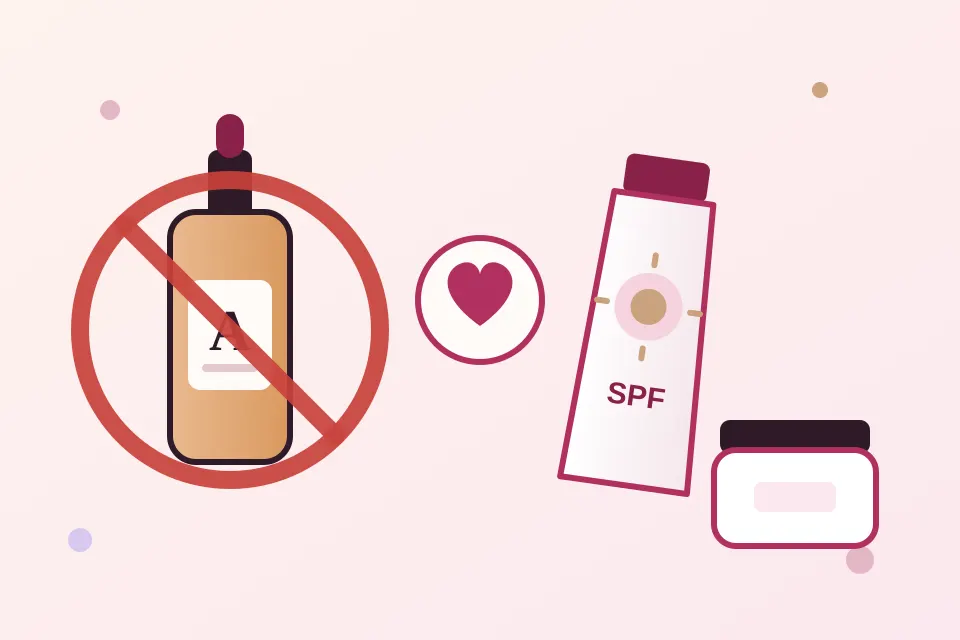
Finding out you’re pregnant tends to turn your bathroom shelf into a quiz. A serum you’ve used for years suddenly has a question mark over it, the internet gives you five different answers, and “pregnancy safe” labels on new products sound reassuring without saying who decided.
The honest picture is shorter than most lists suggest. Dermatologists name a small group of ingredients to stop, a few more to use sparingly, and leave everything else to a conversation with your doctor. This guide covers that list, what the sources actually say, what dermatologists suggest you use instead, and how the pregnancy notes on our product pages work.
Why does skincare need a second look during pregnancy?
Some prescription skin medicines are known to cause birth defects. Isotretinoin, the acne pill, is the best known, and the American Academy of Dermatology (AAD) says to stop it immediately if you become pregnant. Several cosmetic ingredients are chemical relatives of those medicines, which is why they get the same caution even though far less of them reaches the bloodstream from a cream.
The other reason is absorption. A 2011 review in Canadian Family Physician notes that only a small amount of most topical products is absorbed, but that 35% to 45% of applied hydroquinone is, which it calls substantial.
What’s missing is research. Pregnant people are rarely included in cosmetic studies, so most ingredients have no pregnancy data at all. That gap is why advice here is cautious, and why “no evidence of harm” never quite means “shown to be safe”.
Skin Realist check: “pregnancy safe” on a jar is a marketing phrase, not a certificate. Nobody runs a pregnancy safety test on a moisturizer and hands out a badge.
Which skincare ingredients should you avoid while pregnant?
The AAD’s pregnancy skin care guidance lists ingredients that “should not be used during pregnancy”. The two you’re most likely to find in skincare are retinoids and hydroquinone.
| Ingredient | How it can appear on a label | What the sources say |
|---|---|---|
| Retinoids (cosmetic) | Retinol, retinal (retinaldehyde), retinyl palmitate, retinyl propionate, retinyl linoleate, hydroxypinacolone retinoate | The AAD includes over-the-counter retinoids in its do-not-use list |
| Retinoids (acne) | Adapalene (sold over the counter in the US), tretinoin, tazarotene, isotretinoin | The AAD says most experts recommend stopping tretinoin and adapalene, and to stop tazarotene and isotretinoin immediately |
| Hydroquinone | Hydroquinone | On the AAD’s do-not-use list; prescription-only in the US |
| Some prescription medicines | Spironolactone, doxycycline, minocycline, tetracycline, finasteride, 5-fluorouracil | On the AAD’s do-not-use list; talk to your prescriber before stopping anything |
Retinoids, including retinol
Retinoids are vitamin A ingredients used for fine lines, uneven tone and acne. In skincare they appear as retinol, retinal and retinyl esters, and as hydroxypinacolone retinoate, sometimes sold as “Granactive Retinoid”. DermNet also says not to use topical retinoids such as tretinoin and adapalene in pregnancy.
The 2011 review is careful about the evidence: very little topical tretinoin is absorbed, but a few case reports of birth defects exist, so it concludes that pregnant women shouldn’t be encouraged to use topical retinoids until larger studies are done. That reasoning is why the caution extends to the gentler cosmetic forms too.
Watch for retinyl palmitate in unexpected places. It turns up in some moisturizers, eye creams and even a few sunscreens, so read the full ingredient list rather than relying on the product name.
Hydroquinone
Hydroquinone is a skin-lightening ingredient used for dark patches. The FDA says no over-the-counter skin lightening products are legally marketed in the US, and that prescription Tri-Luma is the only FDA-approved hydroquinone drug. If you were prescribed it for melasma before pregnancy, tell your prescriber you’re pregnant. None of the products we track lists hydroquinone, which is why it has no flag on our product pages.
Which ingredients should you use sparingly or ask about first?
The AAD lists a second group to use sparingly and talk over with a dermatologist:
- Salicylic acid above 2%. Common in exfoliating toners, acne treatments and peels. DermNet lists high-concentration salicylic acid among treatments to avoid, and low-concentration products among those most experts consider usable. See our salicylic acid guide.
- Benzoyl peroxide. The AAD’s acne page says experts consider it usable in limited amounts, after you’ve talked to your clinician. The 2011 review notes only about 5% is absorbed through the skin.
- Some essential oils, naming rosemary, basil, jasmine and sage. Our essential oils guide explains how they show up on labels.
- Parabens, phthalates, phenol and triclosan. If you’d rather skip parabens, our label checker can exclude six named parabens from a reviewed list.
We flag salicylic acid on product pages because it’s both common and named with a strength threshold. We don’t flag essential oils or parabens at the product level, because the AAD’s advice is about using them sparingly rather than stopping, and a flag on hundreds of products would drown out the ones that matter most.
Also worth knowing: bakuchiol is often sold as a pregnancy-friendly retinol alternative. It isn’t a retinoid, but we found no pregnancy studies of it, so treat it like any other ingredient and ask first.
Skin Realist check: pregnancy is a fine time for a boring routine. Cleanser, moisturizer and sunscreen don’t make exciting reading, which is rather the point.
What can you use instead?
The AAD’s pregnancy guidance suggests a moisturizer made for your skin type, a broad-spectrum, water-resistant sunscreen of SPF 30 or higher, and a physical sunscreen with zinc oxide, titanium dioxide or both. For color changes such as melasma, it suggests vitamin C in the morning and glycolic acid in the evening. The AAD’s acne page adds that azelaic acid is thought to be usable during pregnancy.
The products below list none of the ingredients we flag. That is a statement about their recorded labels, not a safety clearance, so take the ingredient list to your doctor or pharmacist before you start one.
A mineral sunscreen: CeraVe Hydrating Mineral Sunscreen SPF 30 Face Lotion
CeraVe Hydrating Mineral Sunscreen SPF 30 Face Lotion uses titanium dioxide 6% and zinc oxide 5% as its sunscreen filters, the physical filters the AAD suggests in pregnancy, with ceramides, niacinamide and hyaluronic acid. CeraVe sells it as fragrance free and lists it for all skin types, including sensitive skin.
Sunscreen matters more than usual now, because pregnancy hormones make melasma more likely and sun keeps it going. The caveat: our record says the brand doesn’t state water resistance, and the AAD suggests a water-resistant formula for sweat and swimming.
A gentle cleanser: CeraVe Hydrating Facial Cleanser
CeraVe Hydrating Facial Cleanser is a cream cleanser for normal to dry skin with three ceramides and hyaluronic acid, free of added fragrance according to CeraVe. It’s a simple swap if your usual cleanser is a salicylic acid wash and you’d rather pause it. Oily skin may prefer a gel cleanser.
→ See the CeraVe Hydrating Facial Cleanser on Amazon
A rich moisturizer: CeraVe Moisturizing Cream
The AAD lists dry and sensitive skin among common pregnancy skin changes. CeraVe Moisturizing Cream is a thick, fragrance-free face and body cream with ceramides, hyaluronic acid and petrolatum, and carries the National Eczema Association Seal of Acceptance. It’s heavy for oily skin on the face, but works well on a stretching belly or dry shins.
For dark patches: vitamin C and glycolic acid
For the morning, CeraVe Skin Renewing Vitamin C Serum lists 10% L-ascorbic acid with ceramides and hyaluronic acid. It also lists alcohol denat., which some dry or sensitive skin finds stinging. For the evening, CeraVe Skin Renewing Nightly Exfoliating Treatment lists a 5% glycolic and lactic acid blend. Introduce one at a time, and if a product stings for more than a moment, stop.
→ Check the vitamin C serum on Amazon
For redness and breakouts: COSRX Azelaic Acid 10 B5 Redness Soothing Cream
COSRX Azelaic Acid 10 B5 Redness Soothing Cream lists 10% azelaic acid with panthenol and niacinamide, and is sold as fragrance free. COSRX positions it for visible redness and post-blemish marks. Prescription azelaic acid is stronger, so if breakouts are your main problem, read our pregnancy acne guide and ask your doctor about both.
→ Read reviews and check price on Amazon
How do the pregnancy notes on DermalGuide work?
Each ingredient guide for a flagged ingredient carries a sourced pregnancy note, and every product whose recorded label lists that ingredient shows the same note near the top of its page:
- Red note: the label lists a retinoid (retinol and its esters, or hydroxypinacolone retinoate). Sources advise not using these during pregnancy.
- Amber note: the label lists salicylic acid. Sources advise using higher strengths sparingly.
Both say the same thing: if you’re pregnant, trying to conceive or breastfeeding, ask your doctor or pharmacist before using it. A product without a note hasn’t been checked as safe. It just doesn’t list anything we flag, and some product records don’t have a complete ingredient list at all.
What about breastfeeding?
The sources above focus on pregnancy. The AAD notes that a dermatologist can help adjust your treatment plan during pregnancy and breastfeeding, and that’s the right conversation to have, because advice for nursing can differ by ingredient and by where you apply it. Our notes include breastfeeding for that reason: they’re a prompt to ask, not a verdict.
Mistakes to avoid
- Trusting a “pregnancy safe” claim. No official certification exists. Read the ingredient list instead.
- Missing retinoids by name. Retinyl palmitate, retinal and hydroxypinacolone retinoate are retinoids too, and they can appear in eye creams, foundations and sunscreens.
- Stopping prescription medicine on your own. Tell your prescriber you’re pregnant and let them change the plan.
- Swapping to a stronger peel for melasma. High-concentration salicylic acid is on DermNet’s avoid list, and the AAD treats sun protection as the base of any melasma plan.
- Assuming plant-based means studied. Bakuchiol and essential oils have little or no pregnancy research.
The bottom line
Put away anything listing a retinoid or hydroquinone, check the strength of any salicylic acid product, and bring the rest of your routine to your next appointment. If you only add one product, make it a mineral sunscreen such as CeraVe Hydrating Mineral Sunscreen SPF 30 Face Lotion, because it helps with the melasma that pregnancy makes more likely. For breakouts, our acne during pregnancy guide covers what dermatologists suggest.
Sources
- American Academy of Dermatology: Dermatologist-approved pregnancy skin care: the do-not-use and use-sparingly lists, and the suggested moisturizer, sunscreen, vitamin C and glycolic acid routine.
- American Academy of Dermatology: Is any acne treatment safe to use during pregnancy?: advice on isotretinoin, tazarotene, tretinoin, adapalene, benzoyl peroxide and azelaic acid.
- DermNet: Acne in pregnancy: topical retinoids and high-concentration salicylic acid to avoid; low-concentration salicylic acid among usable treatments.
- Bozzo P et al. Safety of skin care products during pregnancy. Can Fam Physician, 2011: absorption figures for hydroquinone and benzoyl peroxide, and the reasoning on topical retinoids.
- FDA: OTC skin lightening products: hydroquinone’s prescription-only status in the US.
These sources give general guidance. They don’t test any product named here, and they don’t replace advice from your own doctor, midwife or pharmacist.
Common questions
Can I use retinol while pregnant?
The American Academy of Dermatology lists retinoids, including over-the-counter retinol, among ingredients that should not be used during pregnancy. That covers retinal and retinyl esters such as retinyl palmitate too. Ask your doctor before restarting one after the birth, especially if you are breastfeeding.
Is salicylic acid OK during pregnancy?
The AAD advises using salicylic acid above 2% sparingly, and DermNet lists high-concentration salicylic acid among treatments to avoid. Low-strength products such as cleansers are generally considered lower risk, but ask your doctor or pharmacist first.
Is any skincare product certified as pregnancy safe?
No. There is no official pregnancy-safe certification for cosmetics, and most ingredients have never been studied in pregnancy. A "pregnancy safe" claim on a label is marketing, so check the ingredient list with your doctor or pharmacist instead.
Is bakuchiol a pregnancy-safe alternative to retinol?
That has not been shown. Bakuchiol is plant-derived and is not a retinoid, but we found no pregnancy studies of it, and being plant-based is not evidence of safety. Ask your doctor before using it while pregnant or breastfeeding.
Can I use hydroquinone while pregnant?
The AAD lists hydroquinone among ingredients not to use during pregnancy, and a review in Canadian Family Physician notes that 35% to 45% of it is absorbed through the skin. In the US it is now prescription-only, so your prescriber will want to know you are pregnant.